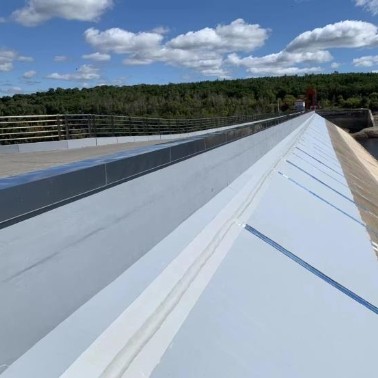
Solvent-Free Hand-Scraped Thick-Film Modified Polyurea Coating
ST800D is a solvent‑free hand‑trowelled modified polyurea coating. This two‑component A:B=1:4 by weight system removes the need for expensive spray equipment, delivering thick‑film anti‑corrosion and abrasion‑resistant protection for industrial floors. Boasting ≥98% solid content, decent pot‑life and strong adhesion to concrete, metal and wood substrates, it withstands acids, alkalis, salt and oil. Suitable for petrochemical, pharmaceutical, food and heavy‑manufacturing workshops and warehouses.
ST800D Manual Trowel-Applied Modified Polyurea
Unlike conventional spray-only polyurea systems that require expensive high-pressure spray rigs, our ST800D modified polyurea is specially engineered for manual trowel application. As a solvent-free two-component protective coating, it delivers thick-film anti-corrosion and wear-resistance performance without specialized spraying machinery — a key advantage for small-to-mid-size industrial flooring and refurbishment projects where on-site spray equipment is unavailable or impractical.
Formulated with ≥98% solid content, this hand-applied polyurea provides extended pot-life for on-site mixing and manual spreading. Once fully cured, it forms a tough, seamless, dense protective film that bonds firmly to metal, concrete and wood substrates. It is widely adopted across petrochemical, pharmaceutical, food-processing, steel-making and power-plant facilities for heavy-duty floor protection.
Key Product Advantages
- Seamless tough dense film: No joints or gaps after curing to block chemical ingress and water penetration.
- Strong multi-substrate adhesion: Reliable bonding to both steel and concrete; no easy peeling or blistering under service loads.
- High mechanical endurance: Outstanding impact, collision and abrasion resistance for heavy-traffic industrial floors.
- Broad chemical resistance: Resists acid, alkali, salt, diesel and crude oil exposure under defined lab test conditions.
- Solvent-free eco-friendly formula: ≥98% solid content, low-VOC for workshops with ventilation requirements.
- Manual trowel application: No polyurea spray machine required; good levelling property shortens overall construction timeline.
Typical Application Areas
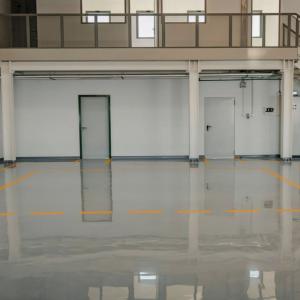
ST800D is developed for heavy-duty floor protection across these industrial sectors: petrochemical plants, cotton textile mills, pharmaceutical factories, breweries, food processing & dairy plants, steel manufacturing, power plants, mechanical processing workshops, pesticide production facilities, warehouse floors and similar industrial concrete or steel floor surfaces.
Technical Specifications
Basic Product Properties
| Item | Specification |
|---|---|
| Cured film appearance | Smooth, bubble-free |
| Solid content | ≥98% |
| Pot-life (25℃, RH 50%) | 0.5 hours |
| Surface dry time (25℃, RH 50%) | ≤8 h |
| Hard dry time | ≤12 h |
| Mixing ratio by weight | A : B = 1 : 4 |
| Theoretical spreading rate | 0.7 kg/m² @500 μm dry film thickness |
Typical Physical Test Performance (lab test data, referenced standards)
| Test Item | Test Standard | Result |
|---|---|---|
| Hardness (sand-filled system) | GB/T 6739-2006 | Shore D 50 |
| Adhesion - metal substrate | HG/T 3831-2006 | 9.3 MPa |
| Adhesion - concrete substrate | HG/T 3831-2006 | 2.8 MPa |
| Bending test (cylindrical mandrel) | GB/T 6742-2006 | ≤1 mm |
| Abrasion resistance (750 g / 500 r) | HG/T 3831-2007 | 5 mg |
| Impact strength | GB/T 1732 | 50 kg·cm |
Corrosion & Chemical Resistance Performance
| Test Item | Lab Result |
|---|---|
| Acid resistance: 30% H₂SO₄ or 10% HCl, 240 h | No corrosion, discoloration or delamination |
| Alkali resistance: 30% NaOH, 240 h | No corrosion, discoloration or delamination |
| Salt resistance: 30 g/L salt solution, 240 h | No corrosion, discoloration or delamination |
| Salt-spray resistance | 1500 h without corrosion / delamination |
| Oil resistance: 0# diesel & crude oil | No corrosion, discoloration or delamination |
| Water resistance: 48 h immersion | No blistering, wrinkling, discoloration, delamination |
Application Guidance & Tools
- Application method: Hand trowel / spatula application. No spray equipment required.
- Recommended dry film thickness: 500 μm – 1000 μm.
- Overcoating interval: Minimum 1 hour, maximum 48 hours. If over 48 h elapsed, or surface is contaminated with dust, abrade with sandpaper and fully clean prior to re-coating.
- Mixing procedure: Mix Component A and B strictly at weight ratio 1:4, stir until fully homogeneous. Add quartz sand / quartz powder, re-stir thoroughly before trowelling onto substrate. Only prepare quantity you can finish within pot-life window.
Construction Environmental Requirements
- Ambient working temperature: 5℃ ~ 35℃
- Relative humidity: 35%-85%
- Concrete substrate requirement: fully cured; pH below 10; substrate moisture content < 10%
- Dew-point rule: substrate temperature shall stay at least 3℃ above dew-point temperature to avoid condensation risk.
Substrate Preparation Guide
Proper surface preparation directly decides final coating service life — this is a frequent source of on-site failure for polyurea flooring projects.
- Metal surfaces: Blast cleaning to ISO 8501-1 / GB 8923 Sa 2.5 grade for rust removal.
- Concrete surfaces: Must be sound, dense, flat, clean and dry. Remove dusting, delamination, cracks and honeycomb defects. Surface patching with putty is normally needed before coating.
- Wood surfaces: Keep clean, dry; remove burrs, loose chips and particles.
- For other special substrates, consult our Huisins technical team for custom recommendations.
Curing Schedule by Substrate Temperature
| Substrate Temperature | Surface Dry | Walk-on Strength | Full Cure |
|---|---|---|---|
| +10℃ | 10 h | 24 h | 21 days |
| +20℃ | 8 h | 12 h | 14 days |
| +30℃ | 3 h | 6 h | 7 days |
Packaging, Storage & Shelf-life
Available packaging kits (A+B two-component set):
- Kit 1: A = 2 kg/can; B = 8 kg/can
- Kit 2: A = 1 kg/can; B = 4 kg/can
Shelf-life: 10 months from production date for unopened original packaging. Storage condition: Store indoors 5-35℃, cool & ventilated area. Avoid direct sunlight.
Important Safety & Application Precautions
- Thoroughly stir Component B before opening and mixing.
- Always follow mixing ratio strictly; only prepare material volume workable inside pot-life to prevent gelation and waste.
- Work within well-ventilated workshop spaces. In case skin or eye contact occurs, rinse with large volume of clean water immediately and seek medical advice if irritation persists.
- During curing process keep coating surface dry and clean; avoid contact with water, alcohols, acids or alkalis.
- For full safety information refer to latest MSDS / SDS document.
Frequently Asked Questions (FAQ)
Q1: What makes ST800D different from spray-applied polyurea?
A: Most polyurea products on market require expensive high-pressure spray machines. ST800D is modified for manual trowel / hand-scraped application. It gives you 0.5 hour pot-life at 25℃ so workers can mix and spread on-site without rush — ideal for smaller refurbishment jobs or workshops without spray equipment access. Note it is still two-component; you must mix A and B at weight ratio 1:4.
Q2: What thickness should I choose for industrial workshop floors?
A: Our recommended dry film thickness window is 500 µm – 1000 µm. At 500 µm, theoretical consumption is 0.7 kg per square meter. For heavy-load, high-abrasion floors (steel plant, mechanical factory), target 800–1000 µm dry film thickness. Reaching higher thickness requires multiple trowel passes — observe the 1-h to 48-h overcoating window between passes.
Q3: Can ST800D apply directly onto raw concrete without primer?
A: Lab adhesion on sound concrete reaches 2.8 MPa (HG/T 3831-2006). But raw concrete must be fully cured, pH < 10, moisture below 10%, free of dust, loose layers and honeycomb defects. For porous, aged or weak concrete, primer and surface patching is strongly recommended, otherwise delamination risk increases in service.
Q4: How long before workers can walk on the coated floor?
A: It depends on substrate temperature. At +20℃, walk-on strength arrives after 12 hours; at low temperature +10℃, wait 24 hours for light pedestrian traffic. Important: walk-on strength ≠ full chemical resistance. Full cure takes 7 days (+30℃) up to 21 days (+10℃). Do not expose the floor to acid-alkali spills before full cure completes.
Q5: Can ST800D stand continuous immersion of strong acid or alkali?
A: Lab tests show 240-hour resistance against 30% H₂SO₄, 10% HCl and 30% NaOH; salt-spray resistance reaches 1500 hours. These are short-term lab exposure results. Continuous long-term immersion of concentrated corrosive media needs independent project-specific testing — we advise a field trial for immersion scenarios.